
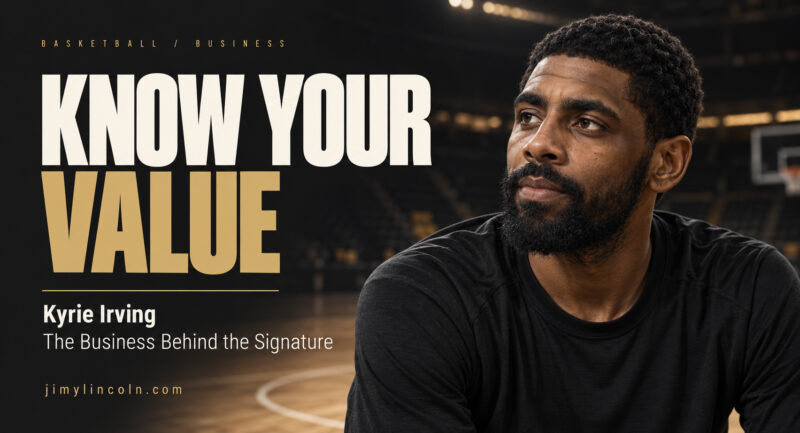
Kyrie Irving’s Anta Deal Shows Why Athletes Must Know Their Business Value
A basketball player can help sell a shoe long after the final buzzer. His game gives it credibility. His personality gives it an identity. The relationship he builds with fans gives people a reason to choose it over another pair on the shelf.
Kyrie Irving’s move from Nike to Anta deserves attention for what it reveals about that relationship. An athlete can bring more to a brand than an audience for its advertising. He can help build a business—and the agreement should recognize that contribution.
As a former two-sport athlete at Georgia Tech, I appreciate the work behind a player’s reputation. From a business perspective, I’m interested in what happens when that reputation becomes a product people buy.
The Scale of Kyrie’s Nike Business
Irving’s commercial track record was substantial. In July 2023, footwear reporter Nick DePaula wrote for Boardroom that Irving’s annual signature business was approaching revenue above $375 million, citing an industry source. That business included his numbered signature shoes, apparel, and more affordable models.
Irving also stated publicly that his signature line had generated more than $2.6 billion in revenue over seven years. That figure should remain attributed to him; it is not a separately verified Nike financial disclosure. Neither number represents profit.
Nike ended its relationship with Irving in December 2022 following his promotion of an antisemitic documentary. Irving subsequently apologized. That context belongs in an accurate account of the separation, even when the focus is his next business chapter.
What interests me is how he approached that next chapter. His relationship with one company ended. His ability to influence basketball consumers remained something he could bring to another negotiation.
Anta Offered a Different Role
Anta announced its partnership with Irving in July 2023, naming him chief creative officer of Anta Basketball. Its announcement described a signature product line and a role recruiting players, designers, artists, and other collaborators to develop additional products under his line.
That scope matters. An athlete contributing to product direction and bringing collaborators into a business is doing work beyond wearing a shoe during games.
The reported financial structure is significant, too. An October 2026 HoopsHype item reproduced reporting attributed to The Athletic that Irving accepted less guaranteed money than Nike had paid him in exchange for a double-digit percentage of signature-line sales—reportedly more than twice the approximately 5% rate signature athletes often receive. His exact percentage remains undisclosed.
That arrangement suggests confidence in his ability to move product. It also carries a trade-off: a larger share of sales can create more upside, while a smaller guarantee provides less certainty.
How Nike Pays Its Athletes
Nike’s own filings provide a clearer explanation of endorsement economics than the headline value of any individual deal.
Its fiscal 2026 annual report describes endorsement payments, achievement bonuses, performance-linked compensation, and, in certain agreements, royalties based on a predetermined percentage of particular product sales. Some contracts include minimum guaranteed royalties. These are company-wide disclosures, not a public schedule of basketball-player rates.
A signature basketball deal therefore cannot be judged by one number. The guarantee matters. So do the products covered, the royalty calculation, and the conditions governing payment. A reported 5% benchmark is not proof that every Nike basketball athlete receives 5%, or that Irving received that rate at Nike.
Nike also acknowledges in its 2026 filing that athletes’ personal brands and athlete-led ventures have increased competition for endorsers. The company recognizes the commercial importance of those relationships in its own assessment of business risk.
A Royalty Percentage Needs a Definition
For an athlete assessing an offer, “a percentage of what?” may be the most valuable question in the room.
Consider a hypothetical $100 million royalty base. Five percent produces $5 million; 10% produces $10 million. But that comparison works only when both percentages apply to the same sales definition and deductions. It tells us nothing about Irving’s actual earnings.
Retail sales, wholesale receipts, and contract-defined net sales can produce different calculations. Athletes and their representatives need to understand what counts, which products qualify, and how they can verify the numbers.
A royalty also does not establish ownership. Equity, intellectual-property rights, creative approval, and compensation are separate issues. A creative title alone cannot tell us what an athlete owns.
The Value Travels With the Player
Brands contribute real resources: design expertise, manufacturing, distribution, marketing, and inventory investment. Those contributions deserve recognition.
So does the player’s ability to make the product matter.
The positive lesson in Irving’s Anta partnership is his willingness to pursue a broader role and, according to reporting, connect more of his compensation to the business he helps generate. His situation is unusual, but the question it raises applies across basketball: does the agreement reflect what the athlete contributes?
For players with proven demand, negotiating should involve more than securing the next endorsement check. It should include understanding the customers they bring, the rights they grant, and the growth they help create.
Kyrie’s next chapter shows why an athlete should arrive at that table with a clear account of his value.
Recent Comments